
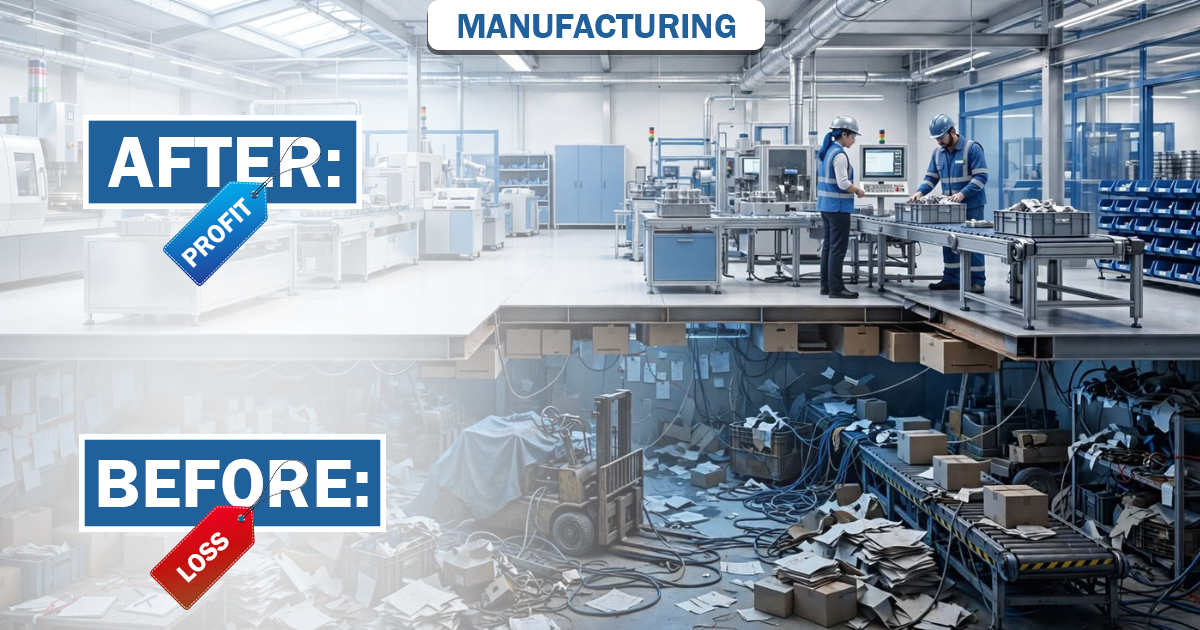
India’s manufacturing growth slowed to a five-year low in August 2026, with slower output and new orders and a rise in finished-goods inventories.
For manufacturing promoters, this makes one question more important:
Where are we losing value while we grow?
Here are 7 gaps worth checking.
1. Capacity Is Available. But How Much Is Actually Productive?
Don’t look only at production achieved.
Look at:
OEE | Downtime | Changeovers | Rejection | Capacity Utilisation
Measure lost capacity — not just completed production.
2. Your Team Is Busy. Is the Business Getting More Output?
More people do not automatically mean more productivity.
Check where time is going:
Waiting | Rework | Manual work | Approvals | Repetitive reporting
The real measure is not “How busy is the team?”
It is:
“How much valuable output is each productive hour creating?”
Recent manufacturing research also identifies organisational complexity and decision bottlenecks as hidden productivity leakages.
3. Inventory May Be Growing Faster Than Your Business
Inventory moves through:
RM → WIP → Finished Goods → Customer → Cash
If that cycle slows, cash gets trapped.
Track:
Inventory Days | Slow-moving Stock | Dead Stock | WIP
Don’t ask only how much inventory you have. Ask how much cash is stuck in it.
4. Revenue Is Growing. But Where Is the Profit?
High-volume business isn’t automatically high-value business.
Analyse profitability by:
Product | Customer | Order
Then factor in:
Discounts + Freight + Rejection + Credit Period + Servicing Cost
Know where revenue comes from — and where profit comes from.
5. How Many Decisions Still Need the Promoter?
If routine decisions keep moving:
Team → HOD → Promoter → Team
you have a scalability problem.
Define:
- Who decides?
- Who approves?
- When does it escalate?
Use RACI, approval limits and escalation mechanisms to make accountability clear.
The goal is not to remove the promoter.
It is to remove unnecessary decisions from the promoter’s desk.
6. You Have Data. Do You Have Decision Clarity?
ERP. Excel. MIS. Reports.
Yet management still asks:
“What needs my attention right now?”
A useful management dashboard should quickly answer:
What changed? → Why? → ₹ impact? → Who owns it? → By when?
Don’t build MIS to report. Build MIS to decide.
7. Is Your Business Dependent on People or Processes?
Ask:
“If a key HOD is unavailable for two weeks, what stops?”
If critical decisions or knowledge sit with one person, scaling becomes difficult.
Build:
Process Ownership + SOPs + Approval Limits + Review Mechanisms
The objective is simple: make performance repeatable, not person-dependent.
The 5-Question Productivity Check
Before adding more capacity, people or systems, ask:
| Question | Focus Area |
|---|---|
| Where are we losing capacity? | OEE / Downtime |
| Where is cash getting stuck? | Inventory / Receivables |
| Where is profit leaking? | Product / Customer Margin |
| Where are decisions slowing down? | Decision Turnaround |
| Where does the business depend on individuals? | Process Ownership |
Then convert each gap into:
₹ Impact + Owner + Action + Timeline
That is where diagnosis becomes implementation.
The Real Manufacturing Advantage
The next productivity gain may not come from simply adding:
- More machines.
- More people.
- More capacity.
It may come from getting more value from:
People + Capacity + Capital + Inventory + Processes
Because:
- More production ≠ more productivity
- More revenue ≠ more profit
- More data ≠ better decisions
- More people ≠ less dependency
The real question is:
How much more value can your business create from what it already has?
From Gaps to Implementation
At SNCO Global, we help business owners and promoters identify gaps across Strategy, Finance and Operations, quantify their impact, build practical action plans and drive implementation.
We don’t stop at identifying the problem.
We help move the business from strategy to implementation.
SNCO Global — We Strategize. We Implement.