
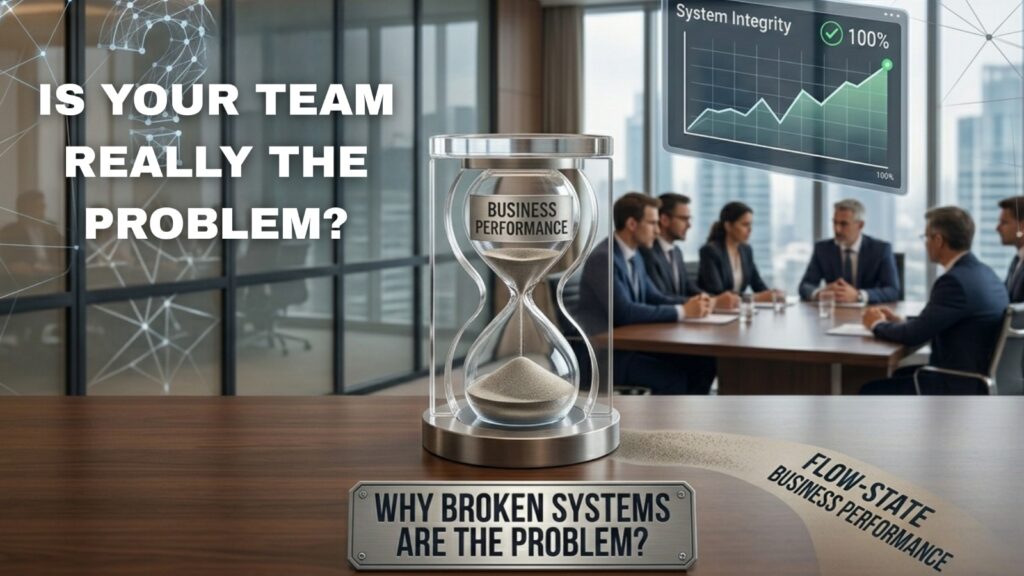
If your team keeps missing deadlines and commitments, your first instinct might be to blame the people. But what if the real problem isn’t your team it’s your system? Discover the 5 critical checks every business owner must make before pointing fingers.
The Most Expensive Mistake Business Owners Make
Picture this: your team missed another deadline. A client is unhappy. Revenue is slipping. Your gut says your employees just don’t care enough. So you start thinking about replacing them.
Stop right there.
This is one of the most expensive and common mistakes business owners make. Hiring and training new employees is costly, time-consuming, and disruptive. And here’s the hard truth: if the system is broken, your new employees will fail just as quickly as the ones you let go.
Before you make any personnel decisions, you need to ask yourself a deeper question: Is the problem my people, or is it my processes?
Why Teams Miss Commitments: The System Problem Nobody Talks About
In most organizations, when something goes wrong, we look for someone to blame. It’s human nature. But research in organizational behavior consistently shows that most performance failures stem from systemic issues not individual incompetence or laziness.
Think of it this way: even a Formula 1 driver can’t win a race in a poorly maintained car. Your team members are like those drivers. Without the right systems, tools, and clarity, even your best people will underperform.
5 Critical System Checks Before Blaming Your Team
Before you make any decisions about your team, run through these five essential checks. If even one of these is broken, your team’s performance will suffer regardless of how talented or motivated they are.
1. Are Tasks Assigned Based on Skills?
Assigning the right task to the right person sounds obvious, but it’s surprisingly rare in growing businesses. When employees are handed work that doesn’t align with their core competencies, failure is almost inevitable.
Ask yourself:
- Do you know each team member’s strengths and skill set?
- Are you assigning tasks based on availability alone, or actual capability?
- Is your team getting proper training to handle assigned responsibilities?
Skill-aligned task assignment is the foundation of high performance. Without it, you’re setting your team and your business up for failure.
2. Is the Work Part of Their Defined Job Role?
Scope creep is a silent performance killer. When employees are constantly assigned tasks outside their job description, it creates confusion, resentment, and overwhelm. When people are asked to handle responsibilities they weren’t hired for and weren’t prepared for their performance on their actual role suffers. This isn’t a motivation problem. It’s a role clarity problem.
3. Do They Have Clear KRAs and Responsibilities?
Key Result Areas (KRAs) define what an employee is ultimately responsible for delivering. Without clearly defined KRAs, your team members are essentially working blind.
When KRAs are undefined or unclear:
- Employees don’t know what ‘success’ looks like in their role
- Prioritization becomes guesswork
- Accountability becomes impossible to enforce fairly
Clear KRAs transform vague expectations into measurable outcomes. They give your team a north star and give you a fair basis for evaluation.
4. Is the Same Task Being Reported to Multiple Managers?
This is more common than you’d think, especially in fast-growing companies. When one task has multiple ‘owners’ or an employee reports to more than one manager on the same project, chaos follows.
Conflicting instructions, duplicated effort, unclear ownership, and political tension between managers all make it impossible for employees to perform well no matter how capable they are.
The fix: every task needs a single owner and a clear chain of accountability.
5. Do You Have Regular Review Meetings With Your Team?
You can’t manage what you don’t measure. And you can’t course-correct what you don’t review.
Regular review meetings serve multiple critical functions:
- They create accountability touchpoints
- They surface blockers before they become missed deadlines
- They allow you to realign priorities as business needs change
- They create a culture of open communication and continuous improvement
Without consistent review cycles, small problems snowball into major failures. By the time you notice something went wrong, it’s often too late to fix it without significant cost.
Pressure Creates Chaos. Systems Create Control.
This is perhaps the most important leadership principle you’ll ever internalize as a business owner.
When performance slips, many leaders respond by increasing pressure tighter deadlines, more frequent check-ins, harsher consequences. But pressure without systems doesn’t solve anything. It just makes the chaos louder and faster.
Systems, on the other hand, create predictability. When your processes are clear, your team knows exactly what’s expected, how to do it, and who to go to when they’re stuck. The result? Fewer missed commitments, less firefighting, and more consistent results.
How to Fix Your System Before Replacing Your Team
Here is a practical action plan to get started:
- Conduct a skill audit : map each team member’s strengths against their current responsibilities
- Rewrite job descriptions : ensure they are specific, current, and mutually agreed upon
- Define KRAs for every role : make success measurable and visible
- Establish a single-owner rule : every task, project, and responsibility must have one clear owner
- Schedule regular reviews : weekly check-ins and monthly performance reviews are a minimum
These steps won’t fix everything overnight. But they will surface the real issues and give you the clarity to address them with facts rather than frustration.
Final Thoughts: Build Better Systems, Lead Better Teams
Great leaders don’t just manage people. They build environments where people can perform at their best. And that starts with getting your systems right.
The next time your team misses a commitment, resist the urge to immediately assign blame. Instead, run through the five checks above. More often than not, you’ll find the root cause in your processes, structures, and communication not in your people.
Fix the system first. Your team, and your business, will thank you for it.