Your strategy is solid. Your reports look great. Your dashboard is clean. So why does every month feel heavier than the last? The answer isn’t more advice, it’s execution that actually works on the ground.
The Founder’s Paradox: More Advice, More Struggle
There has never been more business advice available than right now. Podcasts, masterclasses, consultants, strategy frameworks founders today are drowning in guidance. And yet, most of them are still struggling.
The reason? Advice isn’t the bottleneck. Execution is.
Most founders don’t fail because they don’t know what to do. They fail because what they know isn’t translating into how their business actually operates day to day. The gap between strategy and reality is where growth goes to die and most consulting models don’t address it at all.
The Illusion of Clean Dashboards
Here’s a scenario most founders will recognize:
- Your weekly reports show green across the board
- Your KPIs look reasonable on the dashboard
- Your strategy deck was approved by everyone in the room
And yet, internally, your team is stressed. Processes are leaking. The same problems keep resurfacing. New hires get confused about who does what. Customer complaints are climbing. And you, the founder, are putting in 14-hour days just to hold it all together.
This is what operational chaos looks like when it’s hidden behind polished reporting. The numbers lie. The floor tells the truth.
Why Traditional Consulting Fails Growing Businesses
The traditional consulting model is built around one deliverable: the report. Consultants come in, observe, interview, analyze, and then hand over a thick document full of recommendations. You pay the invoice. They leave. And then nothing changes.
Why? Because the report never had to live on your shop floor. It never had to survive contact with your team’s actual workflows. It was built in a conference room, not in the reality of your business.
Theory-heavy reports and classroom consulting are not solutions. They are a way of making the problem look solved without actually solving it. For founders trying to scale, this approach doesn’t just waste money it wastes precious time at a stage when time is everything.
Growing But Feeling Heavier? Here’s Why
One of the most counterintuitive experiences in business is this: the more you grow, the harder everything feels. More revenue, more clients, more team members and somehow, more stress, more confusion, and more operational drag.
Many founders assume this is just what growth feels like. It’s not.
When growth feels heavier every month, it almost always points to one underlying cause: your operations have not scaled with your revenue. Your systems or lack thereof that worked when you had 5 clients and 3 team members are now being stretched across 50 clients and 20 people. And they are breaking under the weight.
The problem isn’t your growth. It’s the infrastructure or lack thereof that’s supposed to support it.
What Operational Chaos Actually Costs You
Operational inefficiency isn’t just uncomfortable. It has a very real price tag. Consider what’s happening in your business right now if your systems aren’t working:
- Time lost to repetitive, avoidable problems and miscommunications
- Revenue lost to errors, delays, and poor customer experience
- Talent lost because good employees leave chaotic environments
- Energy lost because the founder is stuck firefighting instead of leading
- Growth potential lost because you can’t scale what isn’t systemized
This is the compounding cost of operational chaos. And it grows faster than your revenue does.
What Real Implementation Support Looks Like
True operational support doesn’t start and end with a strategy deck. It starts where most consultants stop: the floor.
Real implementation means getting into the actual workflows of your business. It means working alongside your team to understand where the friction points are, not just documenting them from the outside. It means building process clarity that your people can actually follow not frameworks that look good on slides.
This kind of support focuses on three non-negotiables:
Process Clarity
Every function in your business sales, delivery, operations, finance should have clear, documented processes that don’t live inside one person’s head. When processes are clear, onboarding is faster, errors drop, and consistency improves across the board.
Operational Efficiency
Efficiency isn’t about working harder. It’s about eliminating the structural waste that slows everything down, redundant approvals, unclear ownership, manual tasks that should be automated, and communication gaps that cause work to fall through the cracks.
On-Ground Execution With Teams
This is the piece most consulting firms skip entirely. Real change requires working with your teams, not just presenting to your leadership. It means helping managers understand new processes, helping teams adopt new workflows, and being present during the messy, critical phase of actual implementation.
Why Structured Gap Analysis Changes Everything
Before you can fix what’s broken, you need to know exactly where the breaks are. This is where structured gap analysis becomes a game-changer for scaling businesses.
A proper gap analysis doesn’t just look at your financials or your org chart. It examines the distance between where your operations are today and where they need to be to support your next stage of growth. It maps the friction points, the bottlenecks, the communication failures, and the process gaps that are costing you time, money, and team morale.
Done correctly, a structured gap analysis gives you a clear, prioritized picture of what needs to change and in what order. Not a 60-page report you’ll never open again. A practical roadmap that your team can actually execute.
5 Signs Your Business Needs Operational Implementation Support Now
Not sure if this applies to you? Here are the most common signals that your operations need structured support:
- You’re personally involved in decisions that should be handled by your team
- The same problems keep resurfacing despite repeated team discussions
- New team members take too long to get up to speed
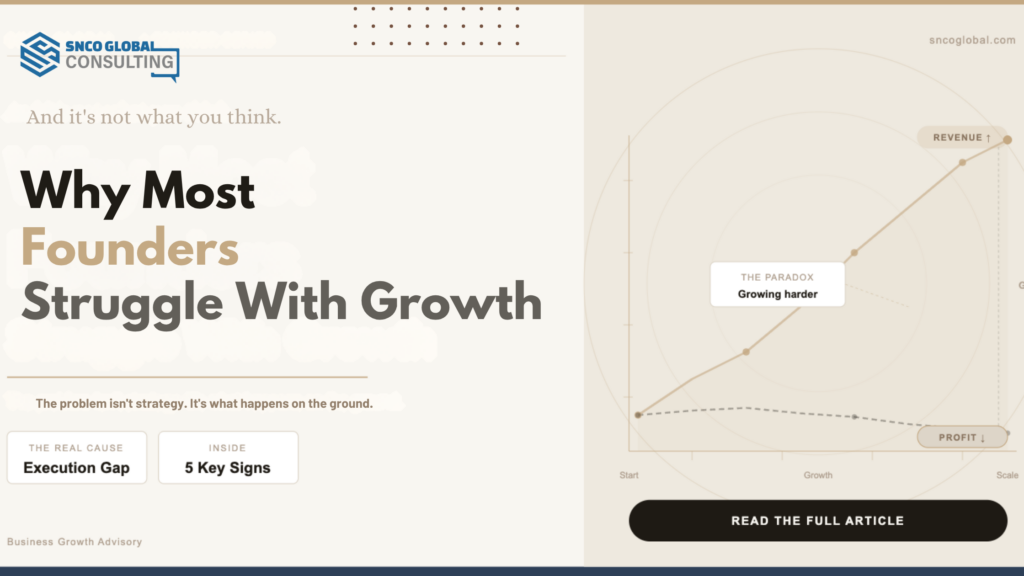
- Revenue is growing but profit margins are shrinking
- You feel like the business runs on you, not with you
If even two of these resonate, your business is ready for structured operational support not more strategy sessions.
Stop Getting Advice. Start Getting Implemented.
The most successful businesses at scale aren’t the ones with the best strategy documents. They’re the ones where the strategy actually lives in their processes, in their teams, and in their day-to-day operations.
If your business is growing but operations feel heavier every month, don’t hire another consultant to tell you what’s wrong. Find a partner who will work inside your business to fix it with your team, on your floor, in your reality.
Because the gap between knowing and doing is exactly where most businesses stop growing. And bridging that gap through structured gap analysis and real implementation support is exactly where the breakthrough begins.