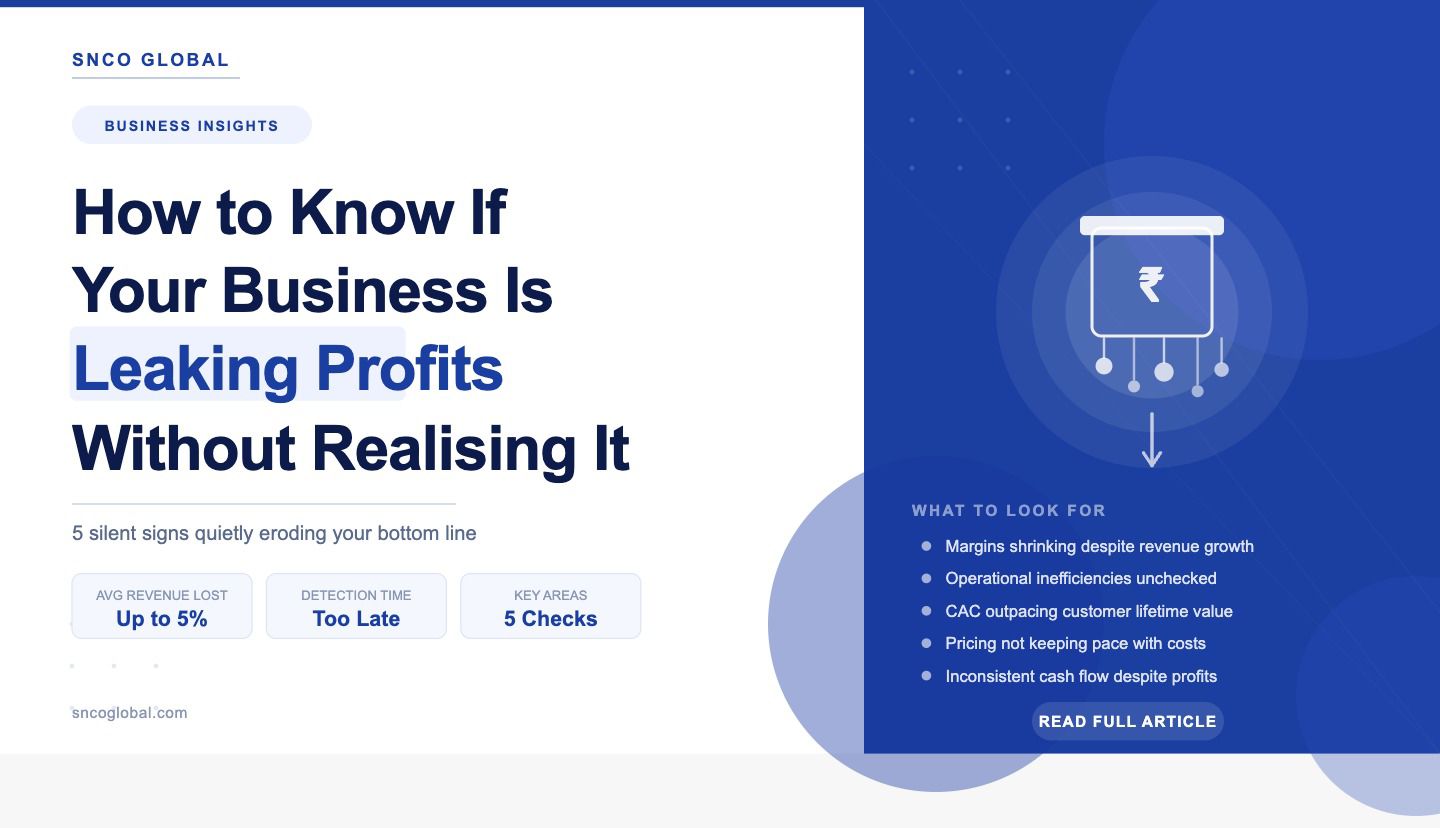
Many business owners find themselves in a perplexing situation: revenue is growing, operations are running, yet the profits at the end of the month simply do not reflect the effort being put in. If this resonates with you, there is a strong possibility your business is experiencing profit leakage a silent, often invisible drain on your financial health.
Profit leakage refers to the gradual loss of revenue or margin through inefficiencies, oversights, and structural gaps within a business loss that rarely appear on the surface but accumulate significantly over time. The unfortunate reality is that most business owners are unaware of these leaks until the damage is already substantial.
This article outlines the most common indicators of profit leakage and provides a structured approach to identifying and addressing them within your organisation.
- Your Revenue Is Growing, But Margins Are Shrinking
One of the earliest and most telling signs of profit leakage is a consistent decline in gross or net margins, even as topline revenue increases. This disconnect typically signals that costs are rising faster than revenue a pattern that, if left unaddressed, can erode business viability entirely.
Common culprits include uncontrolled procurement costs, vendor price escalations that have gone unreviewed, or a product and service mix that has quietly shifted toward lower-margin offerings.
What to do: Conduct a detailed margin analysis by product, service line, and customer segment. Identify which areas of the business are truly profitable and which are simply generating activity without financial return.
- Operational Inefficiencies Are Going Unchecked
Operational inefficiency is one of the most pervasive yet overlooked sources of profit leakage. Redundant processes, underutilised resources, poor inventory management, and excessive manual workflows all consume time and money without adding proportional value to the business.
In many SMEs, these inefficiencies develop gradually a workaround here, an extra step there until they become deeply embedded in daily operations. By the time they are visible, the cumulative financial impact can be significant.
What to do: Map your key operational processes end-to-end and identify bottlenecks, duplication, or steps that do not contribute to output or customer value. A structured operational audit can often reveal savings of 15–25% in process costs alone.
- Customer Acquisition Costs Are Outpacing Lifetime Value
A business can generate impressive sales figures while quietly losing money on every customer it acquires. If your Customer Acquisition Cost (CAC) is too high relative to the Customer Lifetime Value (LTV), the business model itself becomes a source of leakage.
This imbalance is particularly common in businesses that rely heavily on paid advertising, aggressive discounting, or high-touch sales processes without adequate mechanisms for customer retention and repeat revenue.
What to do: Calculate your LTV:CAC ratio across different customer segments. A healthy ratio is generally considered to be 3:1 or higher. If yours falls below this benchmark, revisit your acquisition channels, pricing strategy, and customer retention initiatives.
- Pricing Strategy Has Not Kept Pace with Costs
Many business owners set their pricing early on and rarely revisit it with sufficient rigour. Over time, input costs rise, inflation erodes margins, and the original pricing logic becomes obsolete, yet prices remain unchanged out of fear of losing customers.
This is a particularly silent form of profit leakage because the business continues to appear operational and customer-facing metrics remain stable, while the financial foundation quietly weakens.
What to do: Review your pricing structure annually at minimum. Benchmark against market rates, recalculate your cost-to-serve for each product or service, and ensure that every offering is priced to sustain a healthy contribution margin.
- Cash Flow Is Inconsistent Despite Apparent Profitability
If your Profit & Loss statement shows a healthy bottom line but your bank account tells a different story, this is a classic indicator of cash flow-related profit leakage. Delayed receivables, poor debtor management, overly generous payment terms, and excess inventory tie up capital that should be working for the business.
Beyond the immediate cash pressure, businesses in this position often incur additional financing costs overdraft fees, short-term borrowing, or missed early-payment discounts that further compress margins.
What to do: Tighten your accounts receivable process, review debtor aging reports weekly, and negotiate favourable payment terms with suppliers. Improving your cash conversion cycle is one of the fastest ways to unlock hidden liquidity within the business.
Key Warning Signs to Watch For
If you are unsure whether your business is experiencing profit leakage, look for these indicators:
- Revenue is increasing but net profit remains flat or declining
- You are frequently surprised by the end-of-month financial position
- Overhead costs have grown without a clear corresponding increase in output
- You have not reviewed your vendor contracts or pricing in over 12 months
- Your team is busy, but productivity metrics are unclear or unmeasured
Conclusion: What Gets Measured, Gets Managed
Profit leakage is not inevitable it is a symptom of gaps in financial visibility, operational discipline, and strategic oversight. The businesses that consistently protect and grow their margins are those that approach profitability as an active, ongoing discipline rather than an outcome that takes care of itself.
A structured profitability audit one that examines your costs, processes, pricing, and customer economics with equal rigour is the most effective starting point. The insights that emerge often surprise even the most experienced business owners.
The question is not whether your business has profit leakage. The question is how much and how quickly you are willing to address it. At SNCO Global, we specialise in identifying operational and financial blind spots that quietly erode business profitability. Our team works closely with SME owners and founders to diagnose profit leakage and implement actionable, results-driven strategies. Reach out to us today to begin your profitability audit.